
Review: Just Another PPG Clone? No, the 3rd Wave 8M Can Do More!
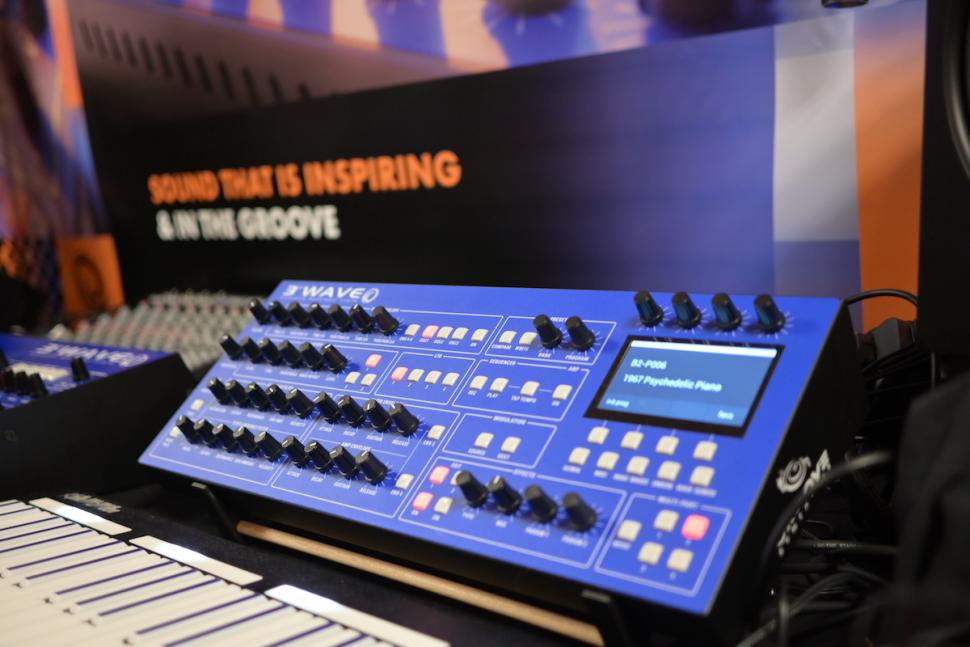
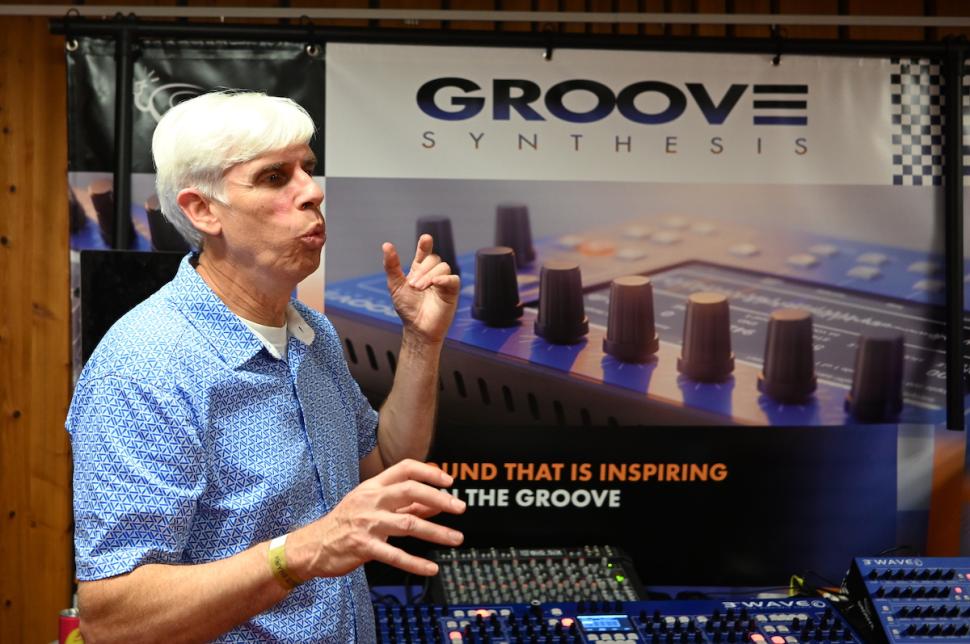
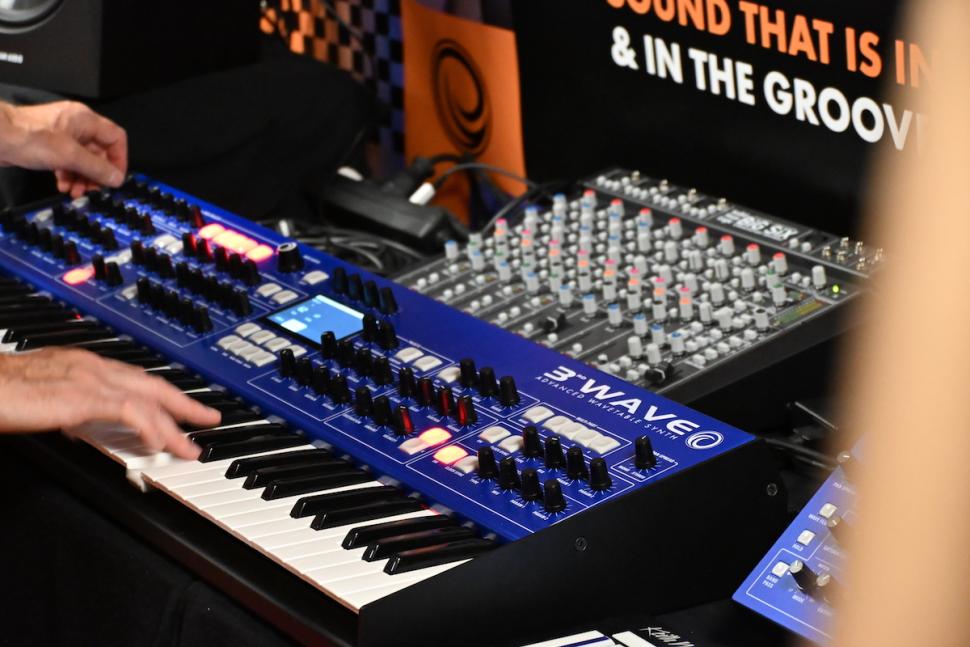
Consequently, we spent quite a while at the Groove Synthesis booth, listening to Bob’s words and the sounds of the 3rd WAVE. And although we’d recently reviewed it, we experienced the synth from a completely different angle this time. That immediately piqued our curiosity about the latest, more compact model from this premier manufacturer: the 3rd Wave 8M.
With the 3rd Wave, the small company Groove Synthesis surprised everyone with a hybrid synthesizer modeled on the legendary PPG Wave and equipped with very extensive features, albeit at a very high price. The smaller 3rd Wave 8M version is significantly more affordable at around 2.000 Euro. We tested how well the 3rd Wave works in the somewhat smaller format.
The sound quality and engine of the 3rd Wave 8M largely correspond to the 24-voice flagship, but with only 8 voices and slightly reduced direct hands-on control. The desktop synthesizer is specialized in wavetable synthesis but additionally offers VA synthesis, FM and sampling as well as analog and digital filters.
High-quality construction
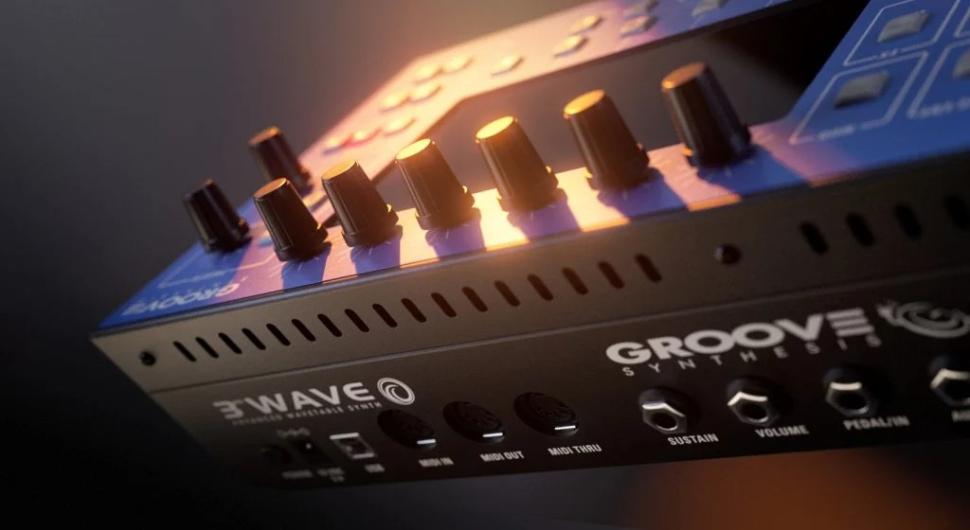
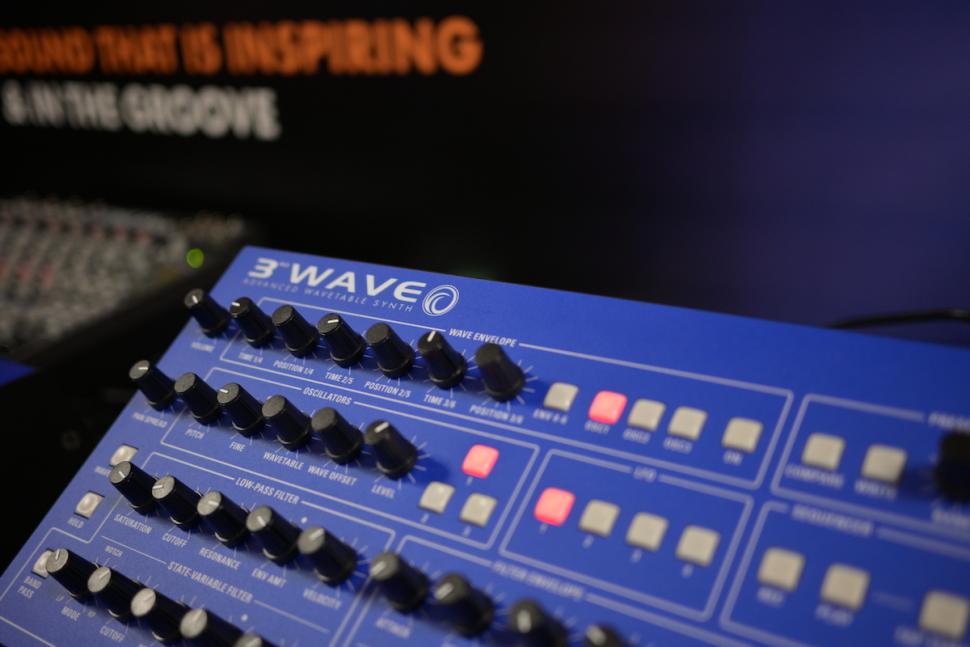
The compact synthesizer can either be placed on a desktop or mounted in a rack using the supplied brackets. The module immediately gives the impression of a high-end instrument. The housing is made entirely of metal, with bolted aluminum sides and a deep blue front panel reminiscent of the 80s classic. Despite the smaller width, the interface does not feel cramped. Groove Synthesis has clearly separated the most important parameter areas such as oscillators, filters and envelopes, and the large color display provides a good overview.
Switches and encoders operate precisely, the OLED display responds quickly and even when stepping through the menus there is hardly any noticeable latency. At around 5 kg in weight and 5U in height, the 8M is not a lightweight, but it is robust enough to withstand touring or use in professional studio racks.
Wavetable meets analog
The basis of the sound generation is formed by three oscillators, and for each oscillator you can choose between wavetables, samples, digital and virtual-analog waveforms. The special thing about this is that the wavetables were not simply taken from old PPG ROMs, but are also available in high-resolution quality. In addition, you can import your own wavetables or even create them directly on the device, which is a huge advantage for sound designers.
Hardware sampler
A sampler is also integrated. It was added to the large 3rd Wave via firmware update and is available from the outset on the 8M. You can even create small multisamples. In combination with the large display with waveform view, it really delivers a hardware sampler feeling, even though the memory as well as the options for post-processing the samples are limited. Since the samples can be used either in pure form or converted into wavetables as the basis of an oscillator, the entire range of further sound shaping options (filters, modulation etc.) is available for additional processing.
Flexible oscillators as a foundation
Each oscillator has independent parameters for position, detune and modulation depth within the wavetable. In combination with frequency modulation and sync, this opens up sonic possibilities that go far beyond classic wavetable synthesis. The basic character of the 3rd Wave, just like its big brother, is a mixture of digital brilliance and analog depth: it can produce crystal-clear pads, glassy textures and metallic digital sounds just as well as classic synth brass and fat, punchy basses that are reminiscent of Sequential classics. In general, the sound is more hi-fi compared to, for example, the early-digital lo-fi character of the original PPG Wave and its Behringer Wave clone. However, you can also easily bend the 3rd Wave in this direction.
The analog soul: filter and amplifier
Groove Synthesis has also equipped the 8M with two filters per voice, which can be operated either in series or in parallel: a digital state-variable filter (SVF) and a classic analog 24 dB lowpass based on Curtis chips. The latter delivers the familiar, warm and transparent Sequential sound with its distinctive resonance that Prophet fans love so much and which works wonderfully with the digital waveforms. The state-variable filter, on the other hand, is more versatile: among other things, it produces bandpass and highpass leads in Oberheim style and makes the 3rd Wave a true sound design machine.
Convincing hybrid sound
In combination with the digital oscillators, an exceptional sound is created that can swing between digital clarity and transparency and analog warmth and imperfection and thus unquestionably possesses the special charm of the PPG Wave. The filters respond musically, their resonance always remains controllable and never becomes unpleasantly sharp and piercing even under heavy modulation. It is particularly worth mentioning that the analog filter compensates for the bass loss and, in contrast to the Prophet-5, ensures that even sounds with high resonance still have plenty of punch!
Modulation matrix creates movement
If you enjoy diving deep into sound design, you will like this synthesizer! The 3rd Wave has a comprehensive modulation matrix with 20 slots in which almost any parameter can be linked as a source or destination. Six LFOs per voice and five envelopes (including one loop envelope) allow for complex sonic movements that can develop rhythmically or chaotically. This clearly goes far beyond the capabilities of a PPG Wave.
Step modulator and MPE
A highlight here is the step modulator. This modulation source, which is integrated into the sequencer, can modulate various parameters per step and proved in the test to be a powerful creative tool for rhythmic textures, morphing pads or lively leads. If you add aftertouch, MPE support and velocity control, the sound engine can be extensively modified while playing, making the 3rd Wave 8M feel like an instrument rather than an electronic device. This definitely connects the small box with the PPG Wave, which, despite its clearly digital sound, also had an unmistakable organic quality. It is definitely worth planning a master keyboard with MPE or at least poly-aftertouch.
Multitimbrality and voices
The 3rd Wave 8M offers eight voices, so a lot has been cut down compared to the large 24-voice model. Each voice has its own filters, envelopes and modulation options. The synthesizer is two-part multitimbral, so you can play two independent sounds including their own effects at the same time. In layer mode these parts can be easily combined into massive textures via the display, although the polyphony is then of course limited due to the maximum of 8 available voices. However, the voice allocation is intelligent and works without audible switching artifacts.
In complex arrangements the system responds stably, and the 8M also convinces with excellent timing in MIDI multimode. Groove Synthesis relies on a modern architecture here and you can feel that while playing.
Polyphonic step sequencer
The integrated polyphonic step sequencer is also very flexible. Unlike many competitors, you can not only record notes but also parameter movements independently, turning the sequencer into a lively performance tool.
With real-time recording, ratcheting and swing functions, I was able to program complex rhythmic structures in the test. Particularly in combination with the modulation system, the sequencer played to its strengths: filter sweeps, wavetable positioning and rhythmic oscillator modulations were implemented cleanly. The workflow is clearly structured and, thanks to display feedback, remains easy to follow.
Exceptional sound
The greatest asset of the 3rd Wave 8M is probably its unmistakable sound. Just stepping through the presets demonstrates the enormous range from floating ambient soundscapes and metallic digital tones to analog brass and lead sounds that easily recall vintage Oberheims or the Prophet-5. The spectrum ranges from cold and precise to warm and dirty, always with a certain 3D depth. Particularly impressive are morphing pads in which several oscillators use different wavetables. And percussive sequences and hybrid leads benefit from the fast envelopes with precise attack and strong transients.
Well-designed operation
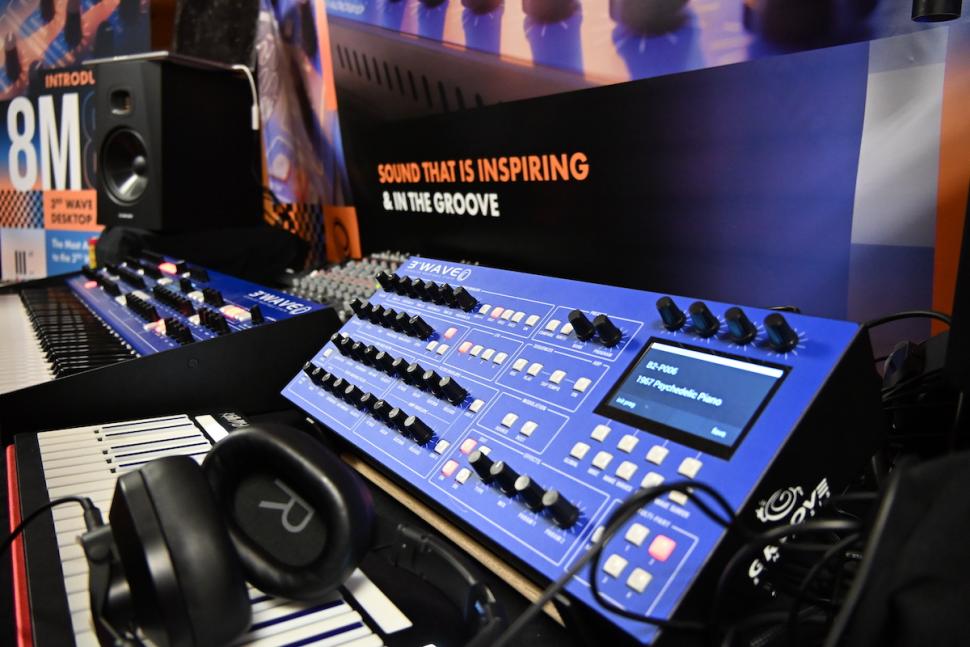
With such a complex synthesizer there is always the risk that sound design will get lost in the menus. But Groove Synthesis has clearly put a lot of care into making the operation logical and fluid. The 3rd Wave 8M has a well-structured interface that keeps important parameters directly accessible, and from my perspective navigation via the main display in combination with the encoders and buttons on the sides is also well implemented.
After I understood the design philosophy, I was able to navigate surprisingly quickly through oscillator layers, filter settings, modulation routing or effect pages during the test. This puts the 8M in pleasant contrast to many modern digital synths whose menus feel overloaded. Of course, things are even faster and more comfortable on the large 3rd Wave keyboard with its many more knobs, but with a bit of practice you quickly get used to the workflow of the desktop module with its limited number of controls.
Effects and dynamics
The 3rd Wave 8M features an internal effects section with reverb, delay, chorus, ensemble, phaser and bitcrusher. The effects are well matched to the sound engine and sound high quality. In particular, the reverb impresses with depth and transparency and blends nicely with both digital and analog sounds. If you prefer to use external effects, you can route each part flexibly to external processors thanks to separate audio outputs. A digital compressor and drive section completes the package. These tools are less about subtle polishing and more about creative sound design: slight overdrive in the filter path can turn the 3rd Wave into warm, shimmering pads, while a focused reverb can turn leads into ethereal atmospheric sounds. In short, the 8M sounds excellent even without external effects, which is a real advantage for small and mobile studios or live performance.
Positioning in the synth market
With its combination of a 24-oscillator architecture (three per voice), analog filters and a powerful modulation engine, the 3rd Wave 8M is in direct competition with instruments such as Waldorf M and Iridium or ASM Hydrasynth. While the Waldorf M emphasizes vintage charm more strongly, you have to do without the analog filter on the Iridium. However, since the Iridium’s digital filters also sound very good and the M has received extended oscillators and multimode filters through various firmware updates, I would consider these two Waldorf synthesizers the closest alternatives. ASM Hydrasynth covers the transparent digital sound very well, but the 3rd Wave is more adaptable in terms of tone.
The Behringer Wave is significantly cheaper and reproduces the PPG Wave domain just as convincingly, but it relies on the cumbersome operation of the original and has nothing to counter the additional functions of the 3rd Wave.
Other more affordable alternatives would be the Korg Modwave mkII or Modal Argon8, but they do not match the sound quality and sonic possibilities of the 3rd Wave. It is particularly worth mentioning that the analog filter compensates for the loss of bass and thus ensures that even sounds with high resonance still have plenty of punch. «
Verdict
The 3rd Wave 8M convinces as a compact desktop/rack version of the large 3rd Wave with its characteristic hybrid sound from wavetables and analog filters. The sound quality is first-class, both for digital sounds and for warm, punchy analog tones. Particularly positive is the enormous sonic depth and flexibility thanks to three oscillators, high-resolution wavetables as well as sampler and virtual-analog sound generation, combined with a clearly structured operating concept. This makes the 3rd Wave not only interesting for lovers of the PPG Wave, but for anyone looking for a great-sounding and flexible synthesizer with a characterful tone. You can clearly tell that a lot of practical experience and attention to detail has gone into the development of the 3rd Wave, and together with the high-quality workmanship this also justifies the comparatively high price for an 8-voice hybrid synthesizer.
Features:
- Desktop synthesizer
- Wavetable, VA, FM and sampling
- 8-voice
- 3 digital oscillators per voice
- Dual filter (analog/digital)
- 2-part multitimbral
- Integrated effects
- 7“ display
Facts:
- Manufacturer: Groove Synthesis
- Web: groovesynthesis.com
- Distribution: retailers
- Price: 1.999 Euro
Pro/Contra:
- Detailed sound
- Flexible with wavetable, sampler, VA
- Analog filter stage with characterful sound
- Wide spectrum from vintage to modern
- Bi-timbral with individual outputs
- Extensive modulation options
- Sequencer
- Excellent build quality
- Large display
- Only 8 voices
Rating:
- Sound: 6 points
- Ease of use: 5 points
- Value for money: 4 points
- Overall: 5 points
Want more? Get more!


Subscribe to the digital edition of BEAT Magazine via Plugins-Samples.com and get more gear, in-depth workshops, reviews and 11 GB exclusive plugins and new sounds with every monthly issue!
Subscribe to Beat Magazine for only 4.99€ per month